
4.2 KiB
title, weight
| title | weight |
|---|---|
| Qdrant Documentation | 10 |
Documentation
Qdrant (read: quadrant ) is a vector similarity search engine. Use our documentation to develop a production-ready service with a convenient API to store, search, and manage vectors with an additional payload. Qdrant's expanding features allow for all sorts of neural network or semantic-based matching, faceted search, and other applications.
First-Time Users:
There are three ways to use Qdrant:
- Run a Docker image if you don't have a Python development environment. Setup a local Qdrant server and storage in a few moments.
- Get the Python client if you're familiar with Python. Just
pip install qdrant-client. The client uses an in-memory database. - Spin up a Qdrant Cloud cluster: the recommended method to run Qdrant in production. Read Quickstart to setup your first instance.
Recommended Workflow:
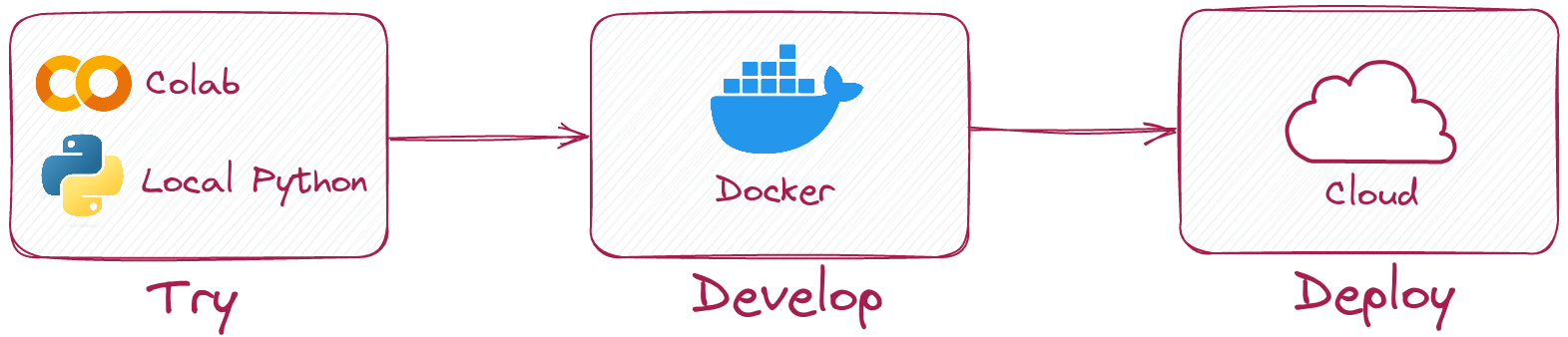
First, try Qdrant locally using the Qdrant Client and with the help of our Tutorials and Guides. Develop a sample app from our Examples list and try it using a Qdrant Docker container. Then, when you are ready for production, deploy to a Free Tier Qdrant Cloud cluster.
Popular Topics:
| Tutorial | Description | Tutorial | Description |
|---|---|---|---|
| Installation | Different ways to install Qdrant. | Collections | Learn about the central concept behind Qdrant. |
| Configuration | Update the default configuration. | Bulk Upload | Efficiently upload a large number of vectors. |
| Optimization | Optimize Qdrant's resource usage. | Multitenancy | Setup Qdrant for multiple independent users. |
Common Use Cases:
Qdrant is ideal for deploying applications based on the matching of embeddings produced by neural network encoders. Check out the Examples section to learn more about common use cases. Also, you can visit the Tutorials page to learn how to work with Qdrant in different ways.
| Use Case | Description | Stack |
|---|---|---|
| Intro to Semantic Search and Recommendations Systems | Learn how to get started building semantic search and recommendation systems. | Qdrant |
| Build a Simple Neural Search | Build and deploy a neural search that browses startup data. | Qdrant, BERT, FastAPI |
| Build a Search with Aleph Alpha | Build a simple semantic search that combines text and image data. | Qdrant, Aleph Alpha |
| Search and Recommend Newspaper Articles | Work with text data to develop a semantic search and a recommendation engine for news articles. | Qdrant |
| Recommendation System for Songs | Use Qdrant to develop a music recommendation engine based on audio embeddings. | Qdrant |
| Question and Answer System with LlamaIndex | Combine Qdrant and LlamaIndex to create a self-updating Q&A system. | Qdrant, LlamaIndex, Cohere |